


Community Memories
Home > Community Memories
Penrith Memories of the Second World War
Welcome to Penrith Town Council’s Second World War Community Memories page. This section brings together a collection of personal recollections, photographs, press cuttings and recorded interviews that capture life in Penrith during the war years.
The material shared here reflects the experiences of local residents and evacuees who lived in Penrith during the 1939–1945 period. Their memories help to preserve an important part of the town’s social and cultural history.
Memories of a Land Girl (Farms around Penrith)
During WW2, women produced much of the nation’s wartime food. Many joined the Women’s Land Army, taking on demanding farm work while many men were away at war.
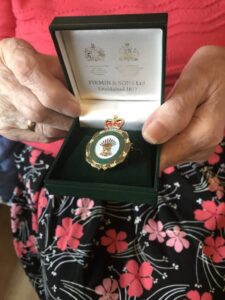
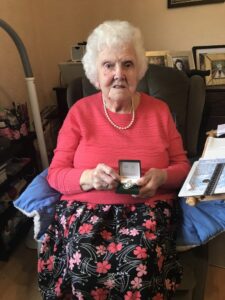
After campaigning, the British Government announced in December 2007 that surviving Land Girls would receive a special Veteran’s Badge, with awards made from July 2008 onwards.
Life in Penrith During WW2 – Childhood Memories
Mr Thompson lived in Penrith throughout the war years and was aged 10 when the war began in 1939. In 1944, he began working locally as an apprentice electrician with Electricity House Ltd. In the video below, he talks about his memories of the war years.
As the video indicates, Mr Thompson was in the Penrith Air Cadets during WW2 and he has provided the photographs in the booklet below. The seaplane is a Sunderland, which was developed in 1937. During World War Two, it was used in the North Atlantic Campaign by Coastal Command to protect the convoys of ships and hunt German U-Boats. In 1940, the Ministry of Aircraft Production decided to disperse some of the production of the Sunderland from Rochester to a more secure location. The aircraft needed a large expanse of water from which to take off therefore it was decided to locate a factory at White Cross Bay on the shores of Windermere.
Life in Penrith During WW2 – Childhood Memories
Video of Mr Twentyman’s memories of Penrith.
Life as normal in Penrith amidst the chaos of War elsewhere!
During WW2, Cumbria was largely safe from attack. Whilst everybody was allocated a strange gas mask, clothes vouchers and ration books, ‘normal’ life didn’t quite fade away for the people who lived in the town throughout the war.
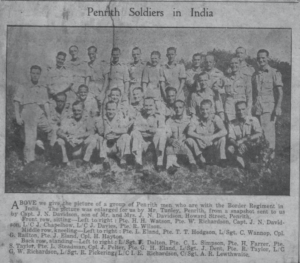
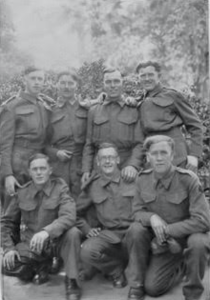
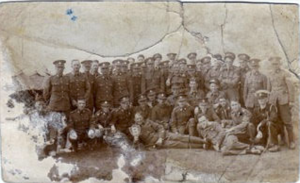
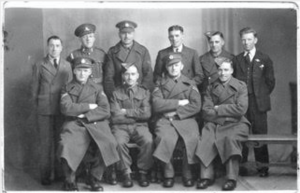
Images of Private George Herbert Eland, who lived in Penrith until his death in April 1982. Courtesy Pte. Eland’s daughter, Jennifer Eland.
- Image 1 – Penrith Soldiers in India. Front row sitting – Left to right: Pte. H.H. Watson, Pte. W. Richardson, Capt. J.N. Davidson, L/C J. Chapelhow, L/C J. Davies, Pte R. Wilson. Midde Row, kneeling – Left to right: Pte. L. Eland, Pte. T.T. Hodson, L/Sgt. C. Wannop, Cpl. G. Railton, Pte. J. Eland, Cpl. H. Hayton. Back Row, standing – Left to right: L/Sgt J. Dalton, Pte. C.L. Simpson, Pte. H. Farrer, Pte. S. Taylor, Pte. L. Steadman, Cpl. J. Pelter, Pte. G.H. Eland, L/Sgt J. Dent, Pte. R. Taylor, L/C G.W. Richardson, L/Sgt. R. Pickering, L/CI. E. Richardson, C/Sgt A.R. Lewthwaite.
- Image 2 – Private George Herbert Eland: Back row first on right
- Image 3 – Private George Herbert Eland: First two kneeling fourth from right
- Image 4 – Private George Herbert Eland: Front row first on right
Newcastle Royal Grammar School (RGS) Evacuation to Penrith during WW2
The RGS was evacuated to Penrith in September 1939, soon after the start of WW2, bringing many young pupils in blue blazers along with Masters and their families to the town where they lived in billets. Not many returned to their native North East until after D-Day, on 6th June, 1944.
‘First Evacuation Trains Arrive’ Local Towns and Villages receive their “guests” (Extract from Newspaper, dated September 2nd, 1939)
“Penrith’s first trainload of evacuees – over 500 schoolboys from the Newcastle Royal Grammar School – have arrived shortly after noon today.
Those responsible for making the arrangements for their reception have been hard at it for weeks, and the efficiency of the organisation was reflected in the smoothness with which it worked.
The train arrived at Penrith Station half a minute before its scheduled time. Ten minutes later, assembled in three groups , the boys were moving off to the schools where they were to receive a meal.
In charge of the whole arrangements was Mrs Hugh V. Thomson, on whom the burden of organisation had fallen very heavily, she having directed the work of the voluntary staff with much tact and efficiency. Her assistants included teachers from Penrith schools, special constables, members of the Voluntary Aid Detachment (V.A.D.) and Air Raid Precautions (A.R.P.)volunteers.”
Video of Mr Richard Robson, evacuated to Penrith 1939
Video of Mr Richard Robson’s memories of being evacuated to Penrith.
Another memory from Richard’s draft of his schoolboy memories.
“One memory is that we actually saw Blackburn Bothas occasionally flying about. I think they were based at Silloth. Strictly speaking it is off the subject, but the Botha is worth a paragraph on its own.. Arguably it was the worst aircraft ever to see service with the RAF. It was grossly underpowered, it was laterally unstable, the field of view out of it was dreadful, it couldn’t maintain height if one of its two engines failed, and it couldn’t be held straight anyway. If both engines failed it had the gliding properties of a brick The cockpit layout was so bad that the fuel cocks could be turned off unintentionally. If this happened unnoticed, the engines would run for about another ten minutes on the collector tank, then they would both cut suddenly to the complete surprise of the pilot. If below 1,000 feet, he had no chance of starting them again before hitting the ground. It was also extremely difficult to escape from. Of course, we were told in those days that all RAF aircraft were marvellous, but the Botha was withdrawn after only a few months. So anyone like me who has seen one is rare nowadays.”
Video of Mr Graham Little, evacuated to Penrith January, 1940.
Video of Mr Graham Little’s memories of being evacuated to Penrith.
Video of George Cottrell, pupil RGS, evacuated to Penrith 1939.
Video of Mr George Cottrell memories of being evacuated to Penrith.